
Series A financials help investors evaluate more than revenue growth or an ambitious business plan. Investors want to understand the company’s financial performance, cash requirements, and ability to support future growth.
Series A investor typically expects historical financial statements, cash-flow forecasts, revenue and operating metrics, and supporting accounting records. Founders should be able to explain the assumptions behind their forecasts, reconcile key figures, and demonstrate how the proposed funding will support future business milestones.
For founders preparing to raise capital, the challenge is ensuring these reports are accurate, consistent, and supported by reliable financial information.
Which Series A Financials Do Investors Expect?
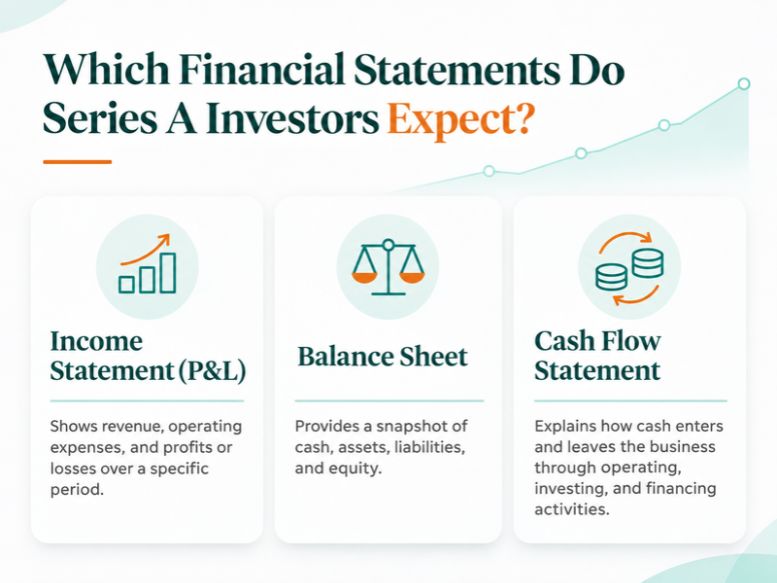
Investors generally review three core financial statements:
- Income Statement (P&L): Shows revenue, operating expenses, and net income or loss over a reporting period.
- Balance Sheet: Shows the company’s assets, liabilities, and equity at a specific date.
- Cash Flow Statement: Shows cash generated and used through operating, investing, and financing activities.
Investors may also request monthly financial reports, year-to-date results, and explanations for significant differences between actual and budgeted performance.
These statements should agree with the company’s accounting records. Unexplained differences can raise questions about financial reporting accuracy.
How Much Cash Runway and Forecasting Detail Is Needed?
Investors want to understand how long the company can operate on its available cash and how it will use additional funding.
Founders should prepare forecasts covering expected revenue, operating expenses, hiring plans, and future cash requirements.
For example, a startup may have 15 months of runway under its current budget. Hiring additional employees could reduce that runway to 10 months.
Investors need to understand both scenarios, the assumptions behind them, and whether the proposed funding will help the company reach its next business milestones.
Forecasts should also show how changes in revenue or spending could affect future funding needs.
You can also read our article: What Does a Fractional CFO Do During Fundraising?
Which Revenue and Unit Economics Metrics Matter?
Investors examine whether the company’s revenue growth is sustainable and how efficiently it operates.
Depending on the business model, important metrics may include:
- Revenue growth and gross margins
- Customer acquisition costs
- Customer retention and churn
- Monthly or annual recurring revenue
- Customer profitability and revenue concentration
For SaaS businesses, reported annual recurring revenue (ARR) should be supported by customer contracts and subscription records. ARR and recognized accounting revenue are different measures, so any differences should be explained.
A pre-revenue biotechnology startup, however, may be evaluated more heavily on development milestones, R&D spending, and funding requirements.
What Accounting Records Should Be Ready for Due Diligence?
Financial statements alone may not satisfy investor due diligence.
Companies should maintain completed monthly reconciliations, consistent accounting policies, accurate ownership records, and documentation supporting significant transactions.
Investors may also review customer contracts, payroll records, convertible notes, SAFEs, and capitalization tables.
These records should be organized and readily available during financial due diligence.
Audited statements are not universally required for every Series A fundraising round. Requirements depend on the investor and the company’s circumstances.
Which Financial Reporting Gaps Delay Series A Diligence?
Even promising startups can encounter difficulties when financial information is incomplete or inconsistent.
Common problems include:
- Different revenue figures in investor presentations and accounting reports
- Outdated financial statements
- Forecasts without clear assumptions
- Missing documentation supporting financial balances
For example, if the pitch deck reports higher revenue than the financial statements, founders should be prepared to explain the difference.
Reliable Series A financials do not require perfect business results. Investors need accurate reporting, consistent records, and credible explanations of financial performance.
Frequently Asked Questions
Not always. Requirements vary by investor and transaction.
Investors may request up to two to three years of available financial statements, or records since inception for younger startups, along with recent monthly results. Requirements vary by investor.
Prepare Your Series A Financials With Astute
Accurate financial statements, reliable forecasts, and well-organized accounting records help founders approach Series A due diligence with greater confidence.
Astute provides CFO advisory, accounting, financial reporting, and forecasting support to help startups prepare the financial information investors need.
Preparing for Series A funding?
Discuss Your Financial Readiness With Astute Or Schedule a Consultation with Astute
Astute supports startups through CFO advisory, financial reporting, accounting, and forecasting services.
Contact Astute to discuss your company’s financial readiness before Series A fundraising.