

Most firms don’t have a cash problem. They have a visibility problem.
Growing ARR, strong investor interest — yet payroll feels tight every month. Sound familiar? This is where cash flow forecasting stops being a finance task and becomes an operating discipline.
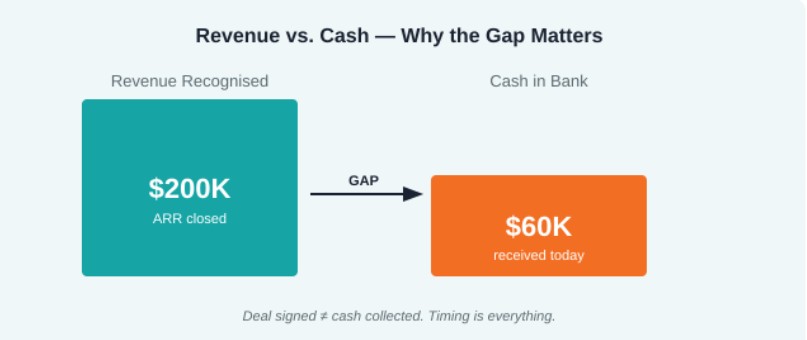
Revenue and cash don’t move together
The gap usually shows up in three ways:
- You hire ahead of revenue hitting the bank
- Deals close fast, but collections take 30–60 days
- Infrastructure and GTM costs ramp faster than monthly cash inflows
Your P&L might say things are working. Your bank balance tells you how long you can keep going.
The three numbers every SaaS company must own
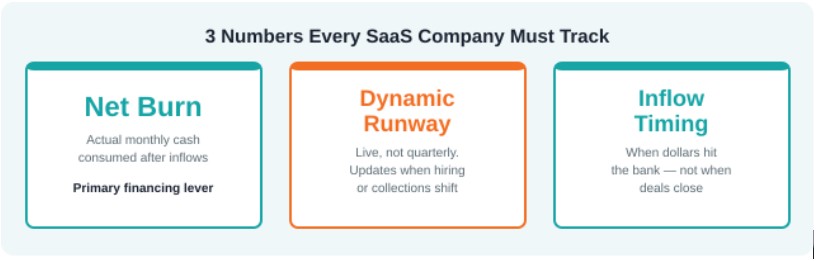
Stop managing from a quarterly board deck. These three metrics need to live inside a rolling forecast that updates as your business moves:
- Net Burn — actual monthly cash consumption after inflows, not just total spend
- Dynamic Runway — recalculates the moment hiring or collections shift
- Inflow Timing — a signed contract is not cash. Map when dollars hit the bank
Where AI is changing the forecast
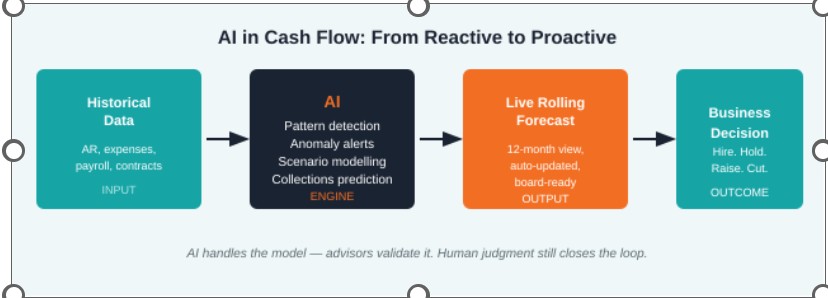
AI is now showing up in bookkeeping and CFO advisory in ways that directly affect cash flow management. For growth-stage companies, the practical impact is this: AI can flag collection slowdowns, spending anomalies, and runway risks earlier — before they force a reactive decision.
Used well, it shifts your posture from reactive to proactive. Instead of discovering a cash gap at month-end, you see it forming two to three weeks out — with time to act. Tighten AR follow-up. Pause a planned hire. Accelerate a renewal conversation. That window makes all the difference.
But AI is only as reliable as the data behind it. Clean books and a structured forecast aren’t optional — they’re the foundation that makes any AI-assisted insight meaningful.
5 steps to a forecast that actually works
- Track how cash comes in, not just how much. Monthly vs annual billing, upfront vs delayed — map payment behavior, not just revenue targets.
- Separate fixed from variable costs: Salaries and rent can’t be cut quickly. Marketing spend and hiring pace can. Your forecast needs to reflect that distinction.
- Focus on timing, not totals: Expecting $200K this month but it arrives late? You still face a crunch. Build payroll and vendor dates into your model.
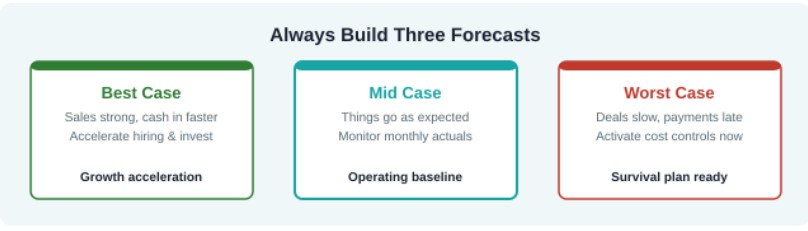
- Run three scenarios: Best case: sales are strong, cash comes in faster. Mid case: things go as expected. Worst case: deals slow down, payments are late. This isn’t pessimism — it’s how you make decisions before you have to.
- Maintain a rolling 12-month view: Update monthly. Compare actuals to forecast. Adjust forward. A forecast you built once and forgot is not a forecast.
Astute: Where financial precision meets cutting-edge technology
At some point, forecasting stops being about a spreadsheet and starts becoming a leadership tool. That’s where Astute comes in.
Astute is not a traditional accounting firm. Over 13 years, we have built a practice that combines the rigor of Big 4 accounting with state-of-the-art financial technology — giving growth-stage companies the kind of cash flow visibility that used to be available only to companies with a full in-house finance team.
For SaaS and growth-stage companies, that means:
- Driver-based cash flow models built around how your business actually collects and spends — not just how it reports
- AI-assisted forecasting tools integrated into your financial model, surfacing early warning signals before they become crises
- Real-time runway visibility that updates as your business moves — not at the end of the quarter
- Investor-ready reporting built directly into your monthly close process
We connect modern financial technology with experienced CFO advisory judgment. The result: companies that see what’s coming, make decisions ahead of the curve, and walk into fundraises and board meetings with complete confidence in their numbers.
FAQs
By projecting collections, mapping expenses, modelling timing differences, and updating a rolling forecast monthly.
Typically, 12–18 months, depending on growth plans, burn rate, and fundraising timing.
Revenue is recognized based on accounting standards. Cash reflects actual payments received — often weeks or months later.
Not in our industry. AI can surface early warning signals and speed up scenario modelling, but it requires clean, well-structured books to be reliable. For accounting and CFO advisory, the value of AI is proactive visibility — catching a cash gap before it becomes a crisis. The judgment call still belongs to your advisor.